
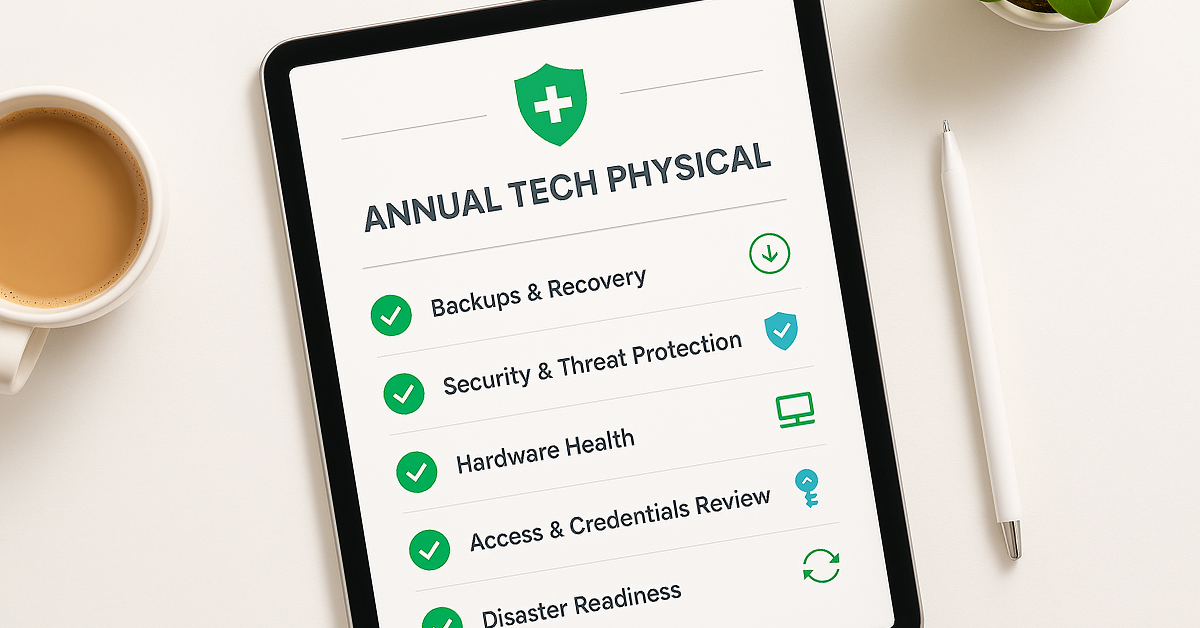

January is the month people finally schedule the things they’ve been putting off.
Doctor. Dentist. Maybe even getting that odd noise in the car checked.
Preventive care is boring but not as boring as a preventable outage.
So, here’s the uncomfortable question:
When was the last time your business tech had a real checkup?
Not “we fixed the printer last week.”
An actual health exam.
Because “working” and “healthy” are two very different things.
The “I Feel Fine” Trap
Most people skip physicals because nothing hurts.
Businesses skip tech checkups for the same reason:
- “Everything’s running.”
- “We’re too busy.”
- “We’ll deal with it if something breaks.”
The thing about tech problems? They rarely announce themselves.
Blood pressure can be high while you feel fine. A cavity can grow without pain. The issue is invisible, until it isn’t.
Technology works the same way.
Common culprits that catch small businesses off guard:
- Known risks that lingered
- Aging equipment that was “fine” until it wasn’t
- Backups that existed but didn’t actually restore
- Access that was never cleaned up
- Compliance requirements nobody reviewed
A system can run every day and still be one bad day away from a major interruption.
What a Real Tech Physical Checks
A solid assessment looks at your environment the way a clinician looks at a patient: systematically, and with an eye for issues you may not see.
Vital Signs: Backup and Recovery
If everything else fails, can you recover?
- Are backups completing successfully?
- When was your last test restore? (Not just scheduled—verified.)
- If a server failed at 9 a.m. Monday, how quickly could you operate again?
Many teams discover backup issues during an emergency. That’s not the moment you want to learn.
Heart Health: Hardware and Infrastructure
Equipment ages out; performance drifts; support ends.
- How old are your core systems (servers, firewalls, workstations)?
- Is anything past vendor support? (No security updates, limited help if it breaks.)
- Do you replace on a schedule, or only when something fails?
Aging gear is a quiet source of downtime: it works… until it doesn’t.
Bloodwork: Access and Credentials
Who has access to what?
- Can you list current users and their roles?
- Are any former employees or completed vendors still active?
- Do shared accounts obscure who did what?
“Access creep” accumulates over time and increases risk.
Readiness Check: Incident & Continuity Plans
Nobody enjoys thinking about worst-case scenarios. That’s why planning helps.
- If you faced ransomware tomorrow, what is the plan?
- Is it written down and tested?
- How long could you operate with systems partially or fully unavailable?
“If it happens, we’ll figure it out” is not a plan.
Specialist Referrals: Compliance & Contractual Needs
Depending on your industry, “healthy” has specific definitions.
- Handling protected health information? Review HIPAA obligations.
- Accepting cards? Confirm PCI requirements.
- Client contracts with security clauses? Ensure you meet them.
You don’t need generic advice, you need guidance aligned to your environment and obligations.
Signs You’re Overdue
If any of these sound familiar, it’s time for a checkup:
- “I think our backups are working.”
- “Our server is old, but it still runs.”
- “We probably have ex-employees still in the system.”
- “We have a disaster plan… somewhere.”
- “If [name] left, we’d be in trouble.”
- “We’d likely struggle with an audit, but nobody’s asked yet.”
The Cost of Skipping
A checkup costs hours.
An incident can cost days or weeks, and real money.
- Data loss: If backups don’t restore, records and files may be difficult or impossible to recover.
- Downtime: Missed deadlines, lost productivity, delayed revenue, strained relationships.
- Compliance issues: Penalties and obligations vary by law and contract; they can be significant.
- Security incidents: Recovery can involve technical remediation, business interruption, and reputational impact.
Prevention is steady and uneventful. Recovery is disruptive and expensive.
Why You Can’t DIY the Physical
You wouldn’t take your own vitals and declare yourself healthy. You see a professional who knows what “normal” looks like, has the right tools, and has seen enough cases to spot patterns.
Technology is the same.
Look for a partner who:
- Knows what “healthy” looks like for a business your size and industry
- Recognizes common failure patterns and early warning signs
- Sees your systems with fresh eyes and identifies what you may have normalized
That’s fire prevention, not firefighting.
Schedule Your Checkup
It’s January. You’re booking other preventive care. Add this to the list.
Book an Annual Tech Physical.
We’ll assess your environment and deliver a plain-English health report: what’s working, what’s at risk, and what deserves attention before it becomes urgent.
No jargon. No pressure. Just clarity.
Schedule your 15-minute discovery call
Because the best time to address a problem is before it becomes an emergency. And the best time to start is now.