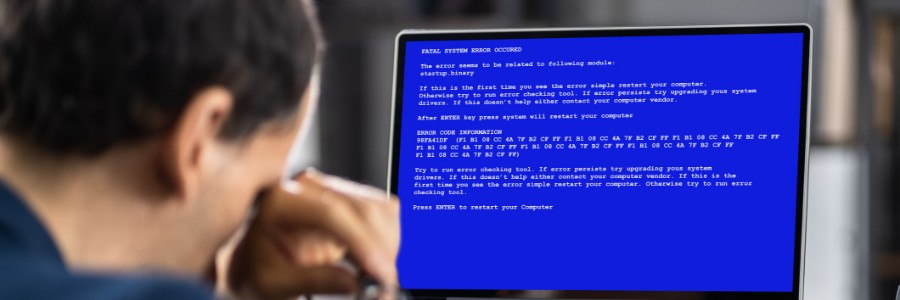
A Windows Update failure is frustrating partly because the error messages rarely explain what actually went wrong. The update either hangs, rolls back, or throws an error code, and the system offers nothing useful about the cause.
An EHR downtime is the kind of event that reveals, quickly and concretely, whether a team has practiced for it or only planned for it. While planning establishes procedures on paper, practice builds the competence needed to carry them out under pressure.
A browser extension with permission to read and change all your data on every website has roughly the same access to your activity as the browser itself. For individual users, that might be an acceptable tradeoff for a useful tool.
An uninterruptible power supply (UPS) is the kind of equipment that gets purchased, installed, and then forgotten about until something goes wrong. The problem with that approach is that UPS batteries degrade, their runtimes shrink, and the workloads connected to them grow over time, often without anyone updating the protection strategy to match.
The back-and-forth of scheduling appointments is one of those low-level operational drains that’s never prioritized until someone calculates how much time it actually consumes. Microsoft Bookings addresses it directly: clients book themselves into available slots, automated messages handle the follow-up, and the schedule stays in sync across your team without anyone managing it manually.
Most website owners underestimate how much their images are affecting their search rankings. File size, format, naming, alt text, and contextual placement all feed into both search engine indexing and page performance. These practices address the most impactful aspects of image optimization.
Rehearsing a presentation without feedback is essentially practicing in the dark. PowerPoint Presenter Coach changes that by analyzing your delivery in real time and giving you specific, actionable feedback on the elements that tend to undermine otherwise good presentations: speaking too fast, relying on filler words, or staying in a monotone throughout.
The time it takes to reach for a mouse, find the cursor, navigate to a button, and click adds up quickly across a workday. Luckily, Windows 10 and 11 include keyboard shortcuts that handle window snapping, taskbar navigation, and desktop management in a single keypress.
Most people have noticed the padlock symbol in a browser’s address bar, but few understand what it actually signals. It is not a general endorsement that a website is safe. It is a specific technical indicator: the connection between your browser and that website is encrypted.
The shift from paper charts to electronic health records (EHRs) has reshaped how healthcare practices manage patient information, coordinate care, and meet regulatory requirements. For practices considering the switch or looking to understand the benefits of EHRs, the evidence is clear: EHRs deliver advantages that paper simply cannot replicate, even accounting for the complexity of implementation.
You deserve stress-free IT. Fed up with chronic computer problems and escalating IT costs? Worried that your backups and cybersecurity are lacking? Sneaking suspicion that your current IT doesn't have a handle on things?
Our Free business IT Optimization Plan will reveal gaps in your network, show how to eliminate your IT problems and never pay for unnecessary IT expenses again.
Have 10 minutes to discuss your IT needs? Click to schedule a convenient time to discuss your free business IT Optimization Plan. Not ready to for a call just yet? Send us a message, and someone on our team will respond shortly.
We use cookies to ensure that we give you the best experience on our website. Unless you've selected "Allow", our website will deactivate the cookies session by default.